

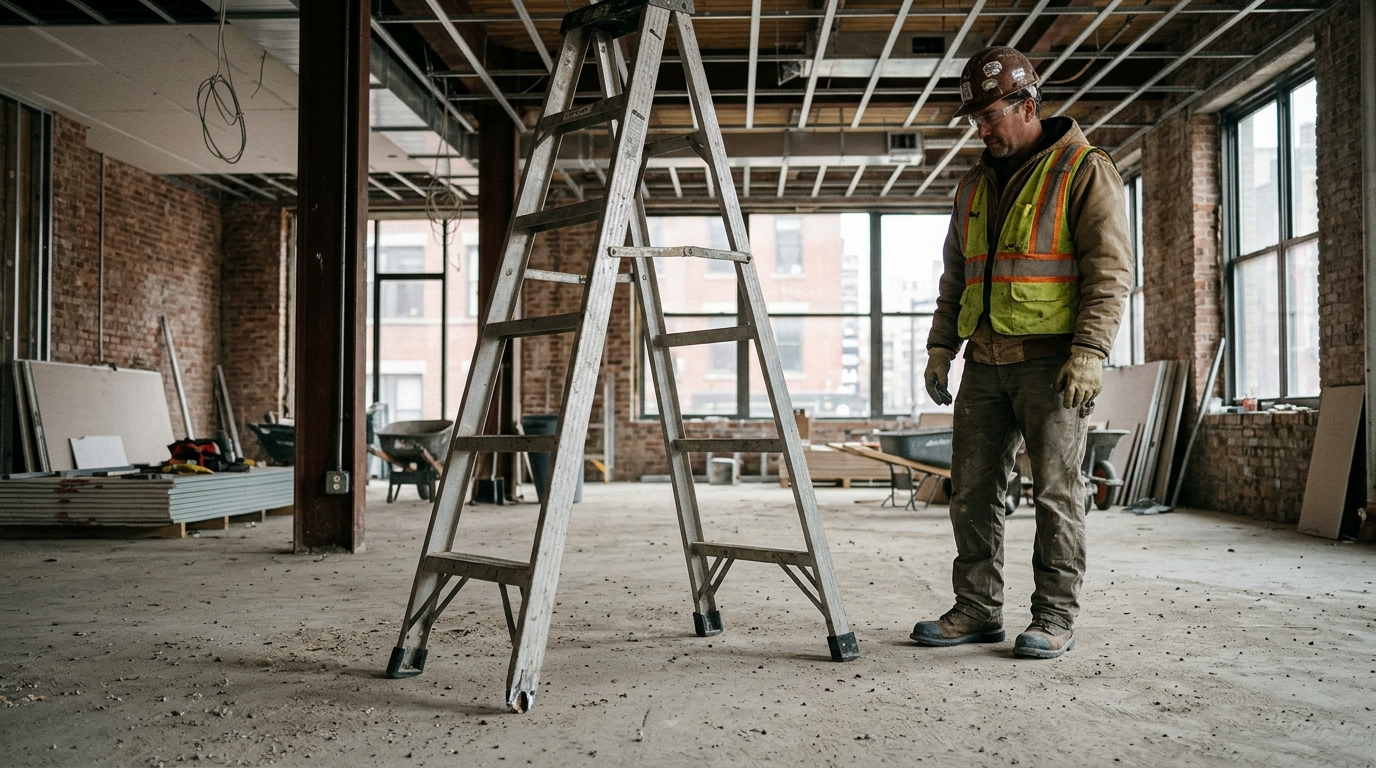
Ladder accidents can cause serious injuries when construction workers fall from unstable, improperly secured, or defective equipment. These incidents may occur during building renovations, electrical installations, plumbing repairs, painting, demolition, and other construction activities requiring access to elevated work areas.
New York provides special legal protections for qualifying construction workers exposed to elevation-related hazards. Under Labor Law § 240(1), covered property owners, contractors, and their agents may face liability when inadequate ladder protection causes an injury.
However, not every ladder fall automatically establishes a valid construction accident claim. The worker’s activity, ladder condition, available safety equipment, accident circumstances, and applicable legal duties must be evaluated.
Quick Answer
Can a construction worker sue after falling from a ladder in New York?
Yes. An injured construction worker may pursue compensation under New York Labor Law § 240(1) when a qualifying elevation-related accident results from inadequate ladder protection and that statutory violation causes the injury.
The statute imposes a nondelegable safety duty on covered property owners, contractors, and their agents. It may apply when a ladder slips, shifts, collapses, or otherwise fails to provide proper protection.
However, the worker must establish that the statute applies and that a safety violation caused the injury. Workers’ compensation benefits and additional claims under Labor Law §§ 241(6) and 200 may also be relevant.
Key Takeaways
- Labor Law § 240(1): New York provides special protections for workers exposed to qualifying elevation-related hazards during specified construction activities.
- Common Ladder Hazards: Unsecured ladders, unstable footing, defective rungs, missing spreaders, and improper placement can contribute to falls.
- Potential Defendants: Covered property owners, general contractors, and qualifying agents may have nondelegable safety responsibilities.
- Equipment Defects: A ladder does not necessarily have to be physically broken for a Labor Law § 240(1) violation to occur.
- Worker Fault: Ordinary comparative negligence does not reduce liability under an established Section 240(1) violation, although a sole-proximate-cause defense may apply.
- Workers’ Compensation: Injured employees may receive workers’ compensation benefits while pursuing legally available third-party claims.
- Important Evidence: Accident photographs, ladder inspections, witness statements, site safety documents, and medical records can help establish a claim.
- Filing Deadlines: Workers’ compensation and third-party injury lawsuits follow different procedural requirements and deadlines.
What Are the Most Common Causes of Ladder Accidents on Construction Sites?
Construction workers use ladders to access elevated work areas, install building components, perform repairs, and move between different levels of a project.
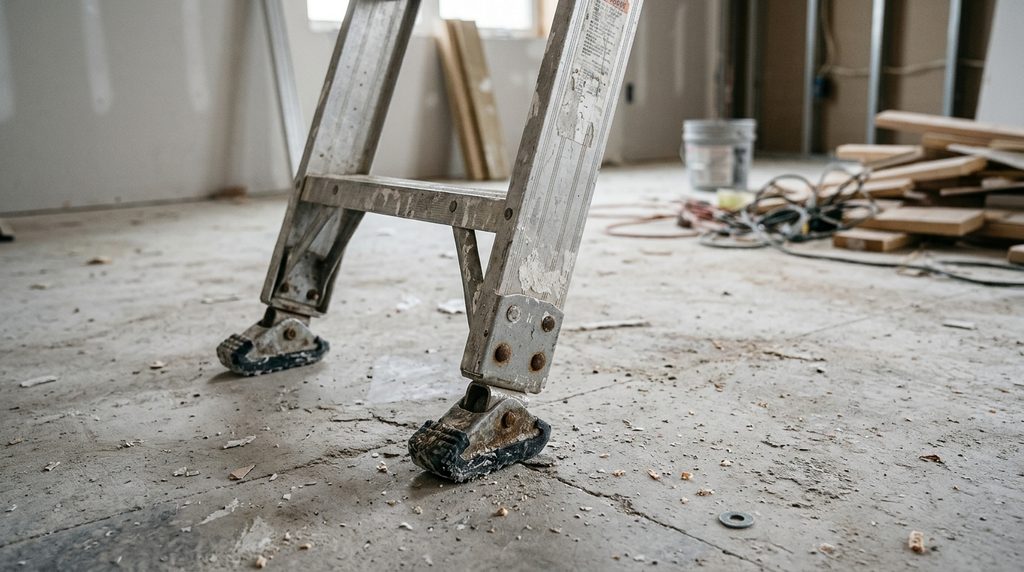
Ladders must remain stable and provide appropriate protection during their intended use. A failure in positioning, equipment condition, or supporting safety measures can create a serious elevation-related hazard.
Unsecured Ladders
An unsecured ladder may slide, shift, or tip over while someone is climbing or working.
Potential problems include:
- Ladders positioned on slippery surfaces
- Missing or worn slip-resistant feet
- Inadequate support at the ladder’s base
- Ladders placed at unsafe angles
- Failure to secure equipment where necessary
- Ladders positioned on uneven flooring
- Improper contact with supporting surfaces
- Movement caused by nearby construction activity
For example, an extension ladder may slide away from a wall while a worker is descending.
The investigation may focus on whether the ladder was appropriately positioned and whether additional protection was necessary.
Defective Ladder Components
Physical defects can compromise a ladder’s ability to support a worker.
Examples include damaged side rails, cracked rungs, loose connections, missing feet, and defective locking mechanisms.
A structurally damaged ladder may fail under normal working conditions.
However, an accident may also involve a ladder that was physically intact but improperly positioned or otherwise inadequate for the work.
Improper Ladder Placement
Ladders may become unstable when positioned on construction debris, uneven surfaces, wet flooring, or other unsuitable foundations.
An extension ladder placed at an improper angle may also create a slipping hazard.
The relevant questions include whether the equipment was appropriate for the work and whether its placement provided adequate protection.
Missing or Defective Spreader Bars
A-frame ladders generally contain spreaders or locking mechanisms that keep their front and rear sections properly positioned.
When these mechanisms are absent, damaged, or improperly engaged, the ladder may become unstable.
A worker may fall if the ladder unexpectedly folds or shifts.
Using an Inappropriate Ladder
A ladder that is too short, unsuitable for the working area, or incompatible with the required task may fail to provide proper protection.
For example, a worker installing overhead equipment may need a different access system when the available ladder cannot safely support the work.
The appropriate equipment depends on the height, working conditions, and nature of the task.
Ladder Movement During Work
Workers may lose balance when a ladder unexpectedly moves while they are drilling, painting, sanding, or installing materials.
Such movement may occur because of inadequate support, loose footing, or improper placement.
Whether the worker was reaching or leaning may become relevant, but the worker’s actions do not automatically eliminate statutory liability.
Unsafe Access Between Building Levels
Ladders are sometimes used to move between construction floors, basements, platforms, and other elevated or lower work areas.
A ladder serving as an access route may create a dangerous condition if it is unstable, unsecured, or unsuitable for repeated use.
The investigation may examine whether the ladder provided proper protection during ascent and descent.
What Types of Ladders Are Commonly Involved in Construction Accidents?
Different ladder designs create different safety considerations.
A-Frame Ladders
A-frame ladders are self-supporting ladders commonly used for interior construction, electrical installations, and finishing work.
Accidents may involve defective spreaders, unstable feet, improper positioning, or unexpected movement.
A ladder that appears structurally intact may still fail to provide adequate protection if it shifts during use.
Extension Ladders
Extension ladders are commonly used to access elevated areas and move between levels.
Their stability depends on appropriate placement, support, and securing where necessary.
An extension ladder may slip outward at its base or move sideways when inadequately stabilized.
Fixed Ladders
Fixed ladders are attached to a structure and may be used to access mechanical areas, roofs, or other locations.
Potential hazards include defective attachments, damaged rungs, inadequate access arrangements, and missing required protection.
However, the applicable standards and legal analysis may differ from those governing portable ladders.
Job-Made Ladders
Some construction sites use ladders fabricated for particular work conditions.
Such equipment must satisfy applicable safety requirements.
Improper materials, unsuitable design, or weak connections may create serious hazards.
Platform Ladders
Platform ladders provide an elevated working surface.
They may be appropriate for certain tasks but still require adequate stability, construction, and use.
Whether a platform ladder was an appropriate safety device depends on the work being performed.
What Is New York Labor Law § 240(1)?
New York Labor Law § 240(1) provides special protections against gravity-related risks during specified construction activities.
It is frequently applied to ladder and scaffold accidents.
The statute requires covered property owners, contractors, and their agents to furnish or erect safety devices that provide proper protection to workers engaged in qualifying activities.
Which Activities Does Labor Law § 240(1) Cover?
The statute identifies work involving:
- Erection
- Demolition
- Repairing
- Altering
- Painting
- Cleaning
- Pointing
These activities must concern a building or structure and fall within the statute’s recognized scope.
For example, installing ductwork during an eligible building alteration may qualify.
However, ordinary routine maintenance performed outside a qualifying construction context may not be covered.
What Safety Devices Does the Law Require?
Section 240(1) identifies ladders, scaffolds, hoists, ropes, braces, and other equipment designed to protect workers against elevation-related hazards.
The safety devices must be properly constructed, placed, and operated.
The New York State Senate’s Labor Law § 240 provides the statutory language.
Is Labor Law § 240(1) an Absolute Liability Law?
The statute can impose absolute liability when a covered defendant violates its safety requirements and that violation proximately causes the worker’s injuries.
However, this does not mean every ladder fall establishes liability.
A claimant must demonstrate an applicable statutory duty, a qualifying elevation-related risk, a violation involving inadequate protection, and a causal connection to the injuries.
Does the Ladder Have to Be Broken?
No.
A ladder may violate Section 240(1) even when its structural components are intact.
For example, a ladder that slides because it was not properly secured may fail to provide adequate protection.
New York appellate decisions repeatedly recognize that defective placement or inadequate stabilization can establish a statutory violation.
Does Labor Law § 240(1) Require a Minimum Fall Height?
There is no universal minimum height applicable to every Section 240(1) claim.
The relevant question is whether the injury resulted from a qualifying elevation-related risk and inadequate protection against gravity-related harm.
A relatively short fall may qualify under appropriate circumstances.
The accident’s height and surrounding conditions still matter.
Who Can Be Held Liable Under Labor Law § 240(1)?
The statute identifies covered owners, contractors, and their agents as potentially responsible parties.
The injured worker’s direct employer is not necessarily the only entity involved in the construction project.
Property Owners
Covered property owners may face liability even when they did not personally supervise the ladder work.
Section 240(1) establishes a nondelegable duty.
However, certain statutory exceptions may apply.
General Contractors
General contractors may have responsibility for providing appropriate elevation-related protection during covered activities.
Liability does not necessarily depend on whether the general contractor personally supplied the ladder or directed the worker’s movements.
Construction Managers
A construction manager may qualify as an owner’s or contractor’s statutory agent when it has been delegated sufficient authority concerning the work that caused the injury.
A company is not automatically liable merely because its contract identifies it as a construction manager.
The actual scope of authority matters.
Subcontractors
Some subcontractors may qualify as statutory agents when they have authority to supervise and control the relevant work.
Other subcontractors may face responsibility under separate negligence theories.
A subcontractor’s involvement in the project alone does not establish Section 240(1) liability.
Equipment Manufacturers
When a ladder contains a legally actionable design or manufacturing defect, the manufacturer may potentially face a separate product liability claim.
Such claims involve different legal requirements from Section 240(1).
The claimant must establish the relevant product defect and causation.
What Is the One- and Two-Family Homeowner Exception?
Section 240(1) generally exempts owners of one- and two-family dwellings who contract for qualifying work but do not direct or control it.
The exception depends on the property’s circumstances and the owner’s actual involvement.
It should not automatically be applied to every residential construction project.
An injured worker may consult a construction accident attorney to evaluate the project, responsible parties, ladder condition, and possible Labor Law claims.
How Is Labor Law § 241(6) Different From Section 240(1)?
New York Labor Law § 241(6) establishes additional safety obligations for covered construction, excavation, and demolition work.
It generally requires covered owners, contractors, and agents to comply with applicable safety regulations.
A Section 241(6) claim must ordinarily identify a sufficiently specific and applicable provision of New York’s Industrial Code.
What Is the New York Industrial Code?
The Industrial Code establishes safety requirements for various construction activities.
Part 23 includes regulations concerning ladders, ladderways, scaffolds, working surfaces, and other hazards.
Some provisions may be relevant when ladders are damaged, improperly supported, or used under unsafe conditions.
What Is 12 NYCRR § 23-1.21?
Section 23-1.21 addresses ladders and ladderways.
It includes requirements concerning ladder strength, maintenance, support, placement, and certain types of equipment.
For example, applicable provisions address ladder defects, suitable footing, and locking spreaders.
The New York ladder and ladderway regulations provide the detailed requirements.
Can Both Labor Law Claims Apply?
Yes.
A ladder fall may support claims under both Labor Law §§ 240(1) and 241(6) when the circumstances satisfy the separate legal requirements.
For example, an unsecured ladder may involve inadequate elevation protection and a violation of a specific Industrial Code provision.
However, a Section 241(6) claim must identify an applicable regulation rather than relying only on a generalized allegation of unsafe conditions.
Does Comparative Negligence Apply to Section 241(6)?
Comparative negligence may be relevant to Section 241(6) claims.
This differs from an established Section 240(1) violation, for which ordinary comparative negligence is not a defense.
The distinction is important when evaluating arguments concerning the worker’s own conduct.
What Is New York Labor Law § 200?
Labor Law § 200 reflects a general duty to maintain reasonably safe working conditions.
It is closely associated with common-law negligence principles.
The applicable analysis often depends on whether the accident arose from a dangerous premises condition or the methods used to perform the work.
Unsafe Premises Conditions
When an accident results from a dangerous site condition, liability may depend on whether the defendant created the condition or had actual or constructive notice.
For example, a ladder may be positioned on an unsafe floor surface.
The cause of the hazard and the defendant’s knowledge may become relevant.
Unsafe Work Methods
When the accident results from the way construction work was performed, liability under Section 200 generally requires proof that the defendant had and exercised sufficient supervisory control over the work that caused the injury.
General authority to oversee a project is not necessarily enough.
How Do the Three Labor Laws Differ?
| New York Law | Main Protection | Important Requirement |
| Labor Law § 240(1) | Qualifying elevation-related hazards | Inadequate safety protection must violate the statute and cause the injury |
| Labor Law § 241(6) | Safety during covered construction, excavation, and demolition | A sufficiently specific, applicable Industrial Code violation must contribute to the injury |
| Labor Law § 200 | General workplace safety | Negligence involving relevant control, supervision, creation of a hazard, or notice |
A worker may have several potential legal theories, but each must be evaluated separately.
What OSHA Ladder Safety Rules Apply to Construction Sites?
The Occupational Safety and Health Administration establishes federal ladder safety requirements for construction workplaces.
The relevant regulations appear in 29 CFR § 1926.1053.
These requirements address ladder strength, support, positioning, inspection, and safe use.
Proper Ladder Support
OSHA generally requires ladders to be used on stable and level surfaces unless secured to prevent accidental displacement.
Ladders used on slippery surfaces must be appropriately secured or provided with suitable protection.
However, slip-resistant feet are not a substitute for proper placement and stabilization.
Ladder Positioning
Non-self-supporting ladders generally must be positioned so that the horizontal distance from the top support to the base is approximately one-quarter of the ladder’s working length.
This is commonly described as the 4-to-1 positioning rule.
The requirement helps establish an appropriate angle for the ladder.
Ladder Extension Above Landings
When portable ladders provide access to an upper landing, OSHA generally requires their side rails to extend at least three feet above the landing.
If that extension cannot be provided, alternative securing and grasping arrangements are required under the regulation.
Ladder Inspection
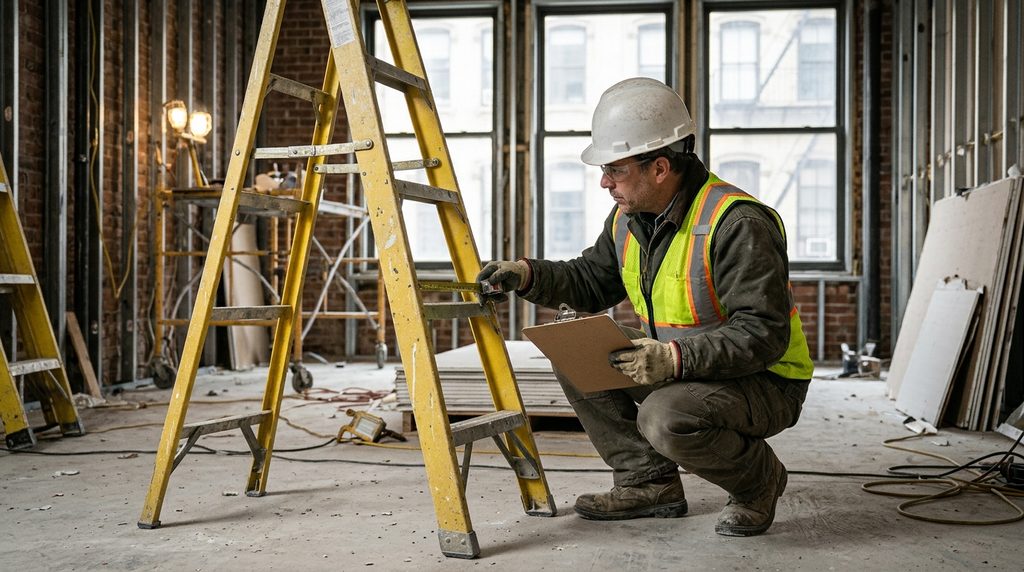
OSHA requires a competent person to inspect ladders for visible defects periodically and after events that could affect their safe use.
Defective ladders must be removed from service in accordance with the applicable requirements.
Safe Ladder Use
Other OSHA requirements address issues such as:
- Keeping ladder steps free of slipping hazards
- Using equipment only for its intended purpose
- Maintaining clear access areas
- Properly securing ladders exposed to traffic or workplace activity
- Avoiding movement of occupied ladders
- Facing the ladder while climbing
- Maintaining an appropriate handhold during ascent and descent
The OSHA construction ladder standard provides the complete requirements.
Does an OSHA Violation Automatically Establish a Labor Law Claim?
No.
OSHA requirements may provide relevant evidence of unsafe practices, but an OSHA violation does not automatically establish liability under New York Labor Law § 240(1) or § 241(6).
A Section 240(1) claim requires the relevant statutory elements.
A Section 241(6) claim generally requires a specific, applicable New York Industrial Code provision.
The legal significance of an OSHA violation depends on the cause of action and circumstances.
What Do Recent New York Court Decisions Say About Ladder Falls?
Recent appellate decisions demonstrate why ladder movement, placement, available safety equipment, and worker conduct are important in Labor Law § 240(1) claims.
Ochoa v. 3475 Third Avenue Housing Development Fund Corporation (2026)
In Ochoa v. 3475 Third Avenue Housing Development Fund Corporation, decided June 11, 2026, a plumber was descending an extension ladder while retrieving materials from a basement during sprinkler installation work.
The ladder was leaned against a wall and had been placed by another worker.
According to the plaintiff, the unsecured ladder slid backward and collapsed while he was using it.
The Appellate Division, First Department affirmed partial summary judgment on liability under Labor Law § 240(1).
The court determined that the ladder’s failure to remain secure established inadequate elevation-related protection.
The defendants argued that the worker could have used another route to retrieve the materials.
However, the court found no sufficient evidence that the worker had been instructed not to use the ladder or was expected to use the alternate route.
The ruling also recognized that retrieving materials for ongoing covered construction work may be an ancillary protected activity.
The official decision in Ochoa provides the court’s reasoning.
Delisle v. FBBT/US Properties, LLC (2026)
In Delisle v. FBBT/US Properties, LLC, decided June 5, 2026, a construction worker was injured when an A-frame ladder shifted during use.
A company employee had covered the ladder’s feet with socks secured by duct tape to protect newly installed flooring.
The worker testified that the modified feet caused the ladder to slide.
The Appellate Division, Fourth Department granted the worker partial summary judgment on liability under Labor Law § 240(1).
The defendants argued that other unmodified ladders were available.
However, the majority concluded that the defendants had not established the worker was the sole proximate cause because he had been instructed to use the modified ladder.
The decision demonstrates why improper alterations to ladder equipment can create serious safety issues and why the mere availability of another ladder does not automatically establish a sole-proximate-cause defense.
The official decision in Delisle provides additional details.
Serrano v. Athena Properties LLC (2026)
In Serrano v. Athena Properties LLC, decided March 19, 2026, a worker fell from a ladder while installing ductwork.
The worker’s testimony and surveillance video showed that the ladder shifted while she began descending.
No other safety devices were made available.
The Appellate Division, First Department determined that the ladder failed to provide proper protection under Labor Law § 240(1).
The court also explained that the worker did not need to establish a structural defect in the ladder.
The defendants argued that the worker’s positioning contributed to the fall.
However, the court determined that the argument did not establish that her conduct was the sole proximate cause of the accident.
The decision highlights the distinction between a physically defective ladder and an inadequately secured ladder.
Robles v. 53-63 Walton LLC (2026)
In Robles v. 53-63 Walton LLC, decided March 17, 2026, a worker was injured after a ladder shifted while he was sanding an area near a staircase.
The worker testified that the ladder was loose, lacked rubber feet, and was the only ladder provided for the work.
The Appellate Division, First Department determined that the worker established entitlement to summary judgment on liability under Labor Law § 240(1).
The defendants argued that the worker contributed to the accident by placing a foot on a railing.
However, the court determined that this argument did not establish sole proximate cause because the worker explained why the available work area required that position and no adequate alternative safety device had been provided.
The ruling illustrates how workplace constraints and equipment availability can affect the analysis.
What Do These Decisions Demonstrate?
These cases establish several important considerations:
- A Ladder Can Be Unsafe Without Being Broken: Movement, instability, or inadequate placement may establish a safety-device failure.
- Available Alternatives Matter: The existence of another ladder does not automatically defeat a claim.
- Worksite Instructions Matter: Directions from supervisors and other personnel may affect sole-proximate-cause arguments.
- Ancillary Work May Be Protected: Accessing materials for ongoing qualifying construction work can fall within Section 240(1).
- Video Evidence Matters: Surveillance footage may resolve disputes concerning how a ladder moved.
- Ordinary Worker Negligence Is Different: Comparative negligence does not reduce an established Section 240(1) claim.
- Liability and Damages Are Separate: Summary judgment on statutory liability does not establish the final amount of recoverable compensation.
Does a Worker Have to Prove the Ladder Was Defective?
Not necessarily.
Under Labor Law § 240(1), the central question is whether the safety device provided proper protection against the relevant elevation-related hazard.
A ladder may be structurally sound but inadequately secured.
For example, a ladder might slide while a worker descends because its feet lack adequate traction or its placement is unstable.
In such circumstances, the failure to provide proper protection may support a claim without proof that a rung or rail physically broke.
However, a fall alone does not automatically establish a statutory violation.
What If the Worker Simply Lost Balance?
A worker who loses balance on an otherwise adequate and properly positioned ladder may face a different legal analysis.
The claim must establish that inadequate safety protection, rather than an unrelated cause, contributed to the accident.
Testimony, photographs, equipment inspection, and video may help identify the circumstances.
What If the Ladder Shifted Suddenly?
Evidence that a ladder unexpectedly shifted, slid, or collapsed during ordinary use may support a Section 240(1) claim.
The investigation should determine whether the movement reflected a failure to provide adequate elevation-related protection.
What If the Worker Cannot Explain the Mechanical Cause?
A worker does not always need to identify the exact mechanical reason a ladder moved.
However, the available evidence must still establish the applicable legal elements.
A credible account of the ladder shifting during use may be significant, particularly when supported by independent evidence.
Can a Worker Be Blamed for a Ladder Fall?
Worker conduct may become relevant in a construction accident claim.
However, the legal rules differ depending on whether the case involves Section 240(1), Section 241(6), or ordinary negligence.
Does Comparative Negligence Apply to Section 240(1)?
Ordinary comparative negligence is not a defense to an established Labor Law § 240(1) violation.
If inadequate safety protection violated the statute and proximately caused the injury, the worker’s ordinary carelessness does not reduce liability under that provision.
However, the worker’s conduct may be relevant when determining whether the statutory violation occurred or whether a sole-proximate-cause defense applies.
What Is the Sole Proximate Cause Defense?
This defense concerns circumstances in which the worker’s own conduct was the only legally sufficient cause of the accident.
The analysis may consider whether:
- Adequate safety devices were available.
- The worker knew the equipment was available.
- The worker understood that they were expected to use it.
- The worker chose without good reason not to use the available protection.
- That choice caused the injury.
The defendant must establish the legally required elements.
What Is a Recalcitrant Worker Defense?
A recalcitrant worker defense may involve a worker who refuses to use available and adequate safety equipment despite being directed to use it.
However, general safety instructions do not automatically establish this defense.
The circumstances must satisfy the applicable legal requirements.
What If the Worker Was Reaching or Leaning?
Reaching or leaning while working may be relevant to accident causation.
However, such conduct does not necessarily establish sole proximate cause.
For example, the available ladder may have been inadequate for the assigned work.
The court must evaluate whether a statutory safety violation contributed to the accident.
What If the Worker Chose the Ladder?
The fact that a worker selected or positioned a ladder does not automatically defeat a Section 240(1) claim.
The analysis must consider whether appropriate safety devices were provided and whether the worker’s conduct was the sole proximate cause.
The availability of a safer alternative and the worker’s instructions may matter.
Can a Worker Receive Workers’ Compensation and File a Third-Party Lawsuit?
Potentially, yes.
Workers’ compensation and third-party personal injury lawsuits provide different legal remedies.
An injured employee may receive qualifying workers’ compensation benefits while pursuing a claim against another legally responsible party.
What Does Workers’ Compensation Cover?
Benefits may include:
- Necessary medical treatment
- Partial wage replacement during qualifying disability
- Benefits for certain permanent impairments
- Rehabilitation-related assistance
- Death benefits for qualifying dependents
Eligibility and payment amounts depend on New York workers’ compensation law.
Can a Worker Sue Their Employer?
Usually, workers’ compensation is the exclusive remedy against a covered employer for a work-related injury.
Workers’ Compensation Law § 11 establishes this general principle, subject to exceptions.
Therefore, an injured worker may be unable to file an ordinary negligence lawsuit directly against the employer.
Who Can Be a Third-Party Defendant?
Potential defendants may include covered property owners, general contractors, qualifying statutory agents, other negligent contractors, and equipment manufacturers.
Their legal duties must be evaluated separately.
Can Both Benefits Be Received?
Yes, when the applicable requirements are satisfied.
However, Workers’ Compensation Law § 29 includes reimbursement and lien rules affecting certain third-party recoveries.
The workers’ compensation carrier may have rights concerning proceeds from a settlement or judgment.
Settlement consent and other requirements may also apply.
Does Workers’ Compensation Cover Pain and Suffering?
Workers’ compensation generally does not provide a separate pain-and-suffering award in the same manner as a personal injury lawsuit.
An eligible third-party claim may allow recovery for qualifying noneconomic damages.
What Evidence Is Important After a Ladder Accident?
Evidence is critical because construction equipment may be moved, repaired, or discarded after an injury.
A ladder that was unstable during the accident may appear normal after being repositioned.
Preserving the original condition and accident circumstances can help establish what happened.
| Evidence | Why It Matters |
| Accident Scene Photographs | Documents the ladder and surrounding work area |
| Ladder Condition | May establish damaged components, missing feet, or improper placement |
| Surveillance Footage | May show the ladder shifting or the worker falling |
| Incident Reports | Records initial accident circumstances |
| Witness Statements | Provides independent accounts of the incident |
| Safety Inspection Records | May identify earlier ladder defects |
| Equipment Inventory Records | Helps establish which ladders and alternatives were available |
| Worksite Instructions | May clarify equipment choices and worker responsibilities |
| Construction Contracts | Helps identify owners, contractors, and agents |
| OSHA Investigation Records | May provide relevant safety findings |
| Medical Records | Documents injuries and treatment |
| Financial Documentation | Supports claims involving lost earnings and other losses |
Photographs of the Ladder
Photographs should document the ladder’s position, feet, rails, rungs, spreaders, and surrounding surfaces.
Useful images may show whether the ladder was positioned on an uneven floor or near construction materials.
Photographs should be taken only when safe.
Ladder Inspection Records
Inspection records may establish whether the ladder was previously found defective.
Equipment maintenance reports and replacement records may also become relevant.
Surveillance Footage
Construction sites, commercial buildings, and adjoining properties may have cameras that recorded the accident.
Video may show whether the ladder moved or whether another event caused the fall.
Witness Statements
Coworkers may describe the ladder’s condition, available equipment, instructions, and accident sequence.
Witnesses may also know whether the same ladder had shifted during earlier use.
Worksite Instructions
Communications with supervisors or other personnel may establish why a particular ladder was used.
These records may become important when a defendant argues that the worker unnecessarily chose unsafe equipment.
Construction Contracts
Contracts help identify the project owner, general contractor, construction manager, and other involved companies.
They may also establish whether a party had delegated authority concerning the relevant work.
Medical Documentation
Medical records help connect the accident to physical injuries and long-term consequences.
Emergency reports, diagnostic imaging, surgery records, rehabilitation notes, and work restrictions may become important.
Understanding the role of evidence for personal injury claims provides additional context about proving negligence, causation, and damages.
What Should a Worker Do After a Ladder Accident?
The immediate priority is emergency assistance and medical treatment.
Once urgent needs are addressed, several steps may help preserve relevant information.
1. Obtain Medical Attention
Ladder falls may cause head injuries, spinal trauma, fractures, and other serious conditions.
Emergency care should not be delayed when serious injuries are suspected.
2. Report the Accident to the Employer
Notify the appropriate supervisor or employer representative.
New York workers’ compensation law generally requires written notice within 30 days, subject to exceptions.
3. Document the Accident Location
Record where the accident occurred and which work activity was being performed.
Details may include the building, floor, room, ladder type, and construction phase.
4. Identify the Ladder
Document the specific ladder involved.
Photographs may help distinguish it from similar equipment at the site.
5. Identify Witnesses
Collect contact information from coworkers who observed the accident or knew about the ladder’s condition.
6. Preserve Relevant Communications
Save messages, work instructions, incident reports, and other documents connected to the accident.
7. Identify the Companies Involved
Record the names of the owner, general contractor, employer, and relevant subcontractors when known.
8. Maintain Medical and Financial Records
Preserve treatment summaries, medical bills, wage records, rehabilitation notes, and work restrictions.
9. File the Appropriate Workers’ Compensation Claim
Qualifying injured workers generally must file a claim with the New York Workers’ Compensation Board within two years, subject to applicable legal rules.
10. Review Potential Third-Party Claims
A Labor Law lawsuit and a workers’ compensation claim involve different procedures.
Applicable filing deadlines should be identified promptly.
What Injuries Can Result From Ladder Falls?
Ladder accidents may cause serious injuries depending on the fall height, landing surface, and impact.
Traumatic Brain Injuries
A worker may strike their head against a floor, wall, equipment, or another structure.
Consequences may include concussion, cognitive difficulties, and more serious neurological impairments.
Spinal Cord Injuries
A ladder fall may cause spinal fractures, disc damage, nerve injuries, or spinal cord trauma.
Severe injuries may lead to permanent disability.
Fractures
Workers may suffer fractures involving the arms, wrists, legs, ribs, pelvis, or spine.
Some injuries require surgery and extended rehabilitation.
Shoulder and Joint Injuries
Attempting to stop a fall may cause shoulder dislocations, torn ligaments, or other joint injuries.
Internal Injuries
A high-impact fall may cause internal trauma requiring emergency treatment.
Long-Term Functional Limitations
Severe injuries may affect mobility, lifting capacity, employment, and independence.
Future medical needs and reduced earning capacity may become important when evaluating damages.
What Compensation May Be Available After a Ladder Accident?
Potential compensation depends on the legal claim, injuries, supporting evidence, and applicable insurance or workers’ compensation benefits.
Medical Expenses
Qualifying third-party claims may include emergency care, hospitalization, surgery, diagnostic imaging, rehabilitation, and future medical treatment.
Workers’ compensation may separately provide medical benefits under its statutory framework.
Lost Income
An injured worker may be unable to perform construction duties during recovery.
A third-party claim may include documented past lost earnings when legally recoverable.
Reduced Earning Capacity
Permanent injuries may prevent a worker from returning to physically demanding employment.
Future earnings losses require medical, vocational, and financial evidence.
Pain and Suffering
A qualifying third-party personal injury lawsuit may allow compensation for physical pain, emotional distress, and reduced enjoyment of life.
Long-Term Care
Serious injuries may require ongoing therapy, mobility assistance, home modifications, or personal care.
These costs may be considered when supported by appropriate evidence.
Wrongful Death Damages
A fatal ladder accident may lead to workers’ compensation death benefits and potentially a separate wrongful death claim against legally responsible third parties.
Different eligibility rules and deadlines apply.
Can Previous Settlement Results Predict Recovery?
No.
Every claim depends on the worker’s injuries, applicable Labor Law provisions, evidence, responsible parties, and other circumstances.
A serious injury does not guarantee a particular settlement amount.
How Long Does Someone Have to File a Ladder Accident Claim in New York?
Different filing requirements may apply to workers’ compensation claims and third-party personal injury lawsuits.
| Claim or Requirement | General Deadline |
| Report a work-related injury to the employer | Generally within 30 days |
| File a workers’ compensation claim | Generally within two years |
| Ordinary personal injury lawsuit against a private third party | Generally three years, subject to exceptions and workers’ compensation coordination rules |
| Certain municipal tort claims | Notice of claim generally required within 90 days |
| Covered municipal negligence lawsuits | Generally one year and 90 days |
| Certain claims against New York State | Special Court of Claims filing and service requirements |
| Wrongful death lawsuit | Generally two years, subject to statutory exceptions |
What Is the Deadline for Reporting a Workplace Injury?
New York Workers’ Compensation Law § 18 generally requires injured employees to notify their employers within 30 days.
Certain exceptions may apply.
Providing accurate written notice promptly can help document the accident.
What Is the Workers’ Compensation Filing Deadline?
Workers’ Compensation Law § 28 generally provides a two-year filing period for accidental workplace injuries, subject to exceptions.
The New York Workers’ Compensation Board’s filing guidance explains the reporting and claim process.
What Is the Deadline for a Third-Party Lawsuit?
Under CPLR § 214(5), many ordinary personal injury actions must be commenced within three years.
However, Workers’ Compensation Law § 29 contains additional rules governing certain third-party actions, carrier rights, and reimbursements.
The applicable filing strategy and deadlines must be evaluated together.
What If the Construction Project Involved a Government Entity?
Claims against certain municipalities may require a formal notice of claim within 90 days under General Municipal Law § 50-e.
Claims against New York State generally involve separate Court of Claims procedures.
Other public authorities may have entity-specific requirements.
It is important not to assume that every construction accident involving a public project follows the same procedures.
Why Should Evidence Be Preserved Early?
Construction activities may continue shortly after an accident.
Ladders may be repaired, replaced, or moved, and witnesses may transfer to different jobsites.
Surveillance recordings may also be overwritten.
Prompt preservation of evidence can be important even when a lawsuit deadline is months or years away.
What Mistakes Can Weaken a Ladder Accident Claim?
Several mistakes may make it harder to establish statutory liability, causation, or damages.
These include:
- Failing to report the accident promptly
- Not documenting the specific ladder involved
- Overlooking worn ladder feet or missing locking mechanisms
- Failing to photograph the ladder’s original position
- Not preserving witness information
- Discarding relevant worksite instructions
- Overlooking the availability of alternative safety equipment
- Assuming every ladder fall establishes a Labor Law § 240(1) violation
- Assuming a ladder must physically break to support a claim
- Confusing ordinary comparative negligence with sole proximate cause
- Failing to identify the owner and general contractor
- Overlooking potential Industrial Code violations
- Assuming workers’ compensation eliminates every third-party lawsuit
- Delaying necessary medical evaluation
- Failing to document permanent work restrictions
- Missing workers’ compensation or lawsuit deadlines
A well-supported claim generally requires evidence connecting inadequate safety protection to the accident and identifying the legally responsible parties.
When May Legal Guidance Be Useful?
Legal guidance may be particularly important when a ladder fall causes significant injuries, permanent disability, substantial medical expenses, or an extended inability to work.

Additional investigation may be necessary when the defendants argue that the ladder was safe, claim the worker chose unsuitable equipment, or dispute whether the work was covered by Labor Law § 240(1).
Complex claims may involve building owners, general contractors, construction managers, subcontractors, workers’ compensation carriers, and equipment manufacturers.
A legal investigation may require photographs, video evidence, ladder inspections, construction contracts, witness statements, safety records, and medical documentation.
People researching local legal assistance may review a Long Island injury law office when seeking information about ladder accidents and construction injury claims in Nassau or Suffolk County.
Every accident requires an individual assessment, and the fact that a worker fell from a ladder does not automatically guarantee compensation.
Frequently Asked Questions About Ladder Accident Claims
Can a construction worker sue after falling from a ladder in New York?
Yes. A worker may pursue a Labor Law § 240(1) claim when inadequate elevation-related protection causes an injury during qualifying work. Covered owners, contractors, and agents may face liability. Workers’ compensation may provide separate benefits, while an eligible third-party lawsuit may permit recovery for additional legally compensable losses.
Does a ladder have to break for Labor Law § 240(1) to apply?
No. A ladder may fail to provide proper protection when it slips, shifts, or collapses despite having no visible structural defect. New York courts examine whether inadequate equipment or placement violated the statute and caused the accident. However, merely falling from a ladder does not automatically prove liability.
Can a worker recover compensation if they placed the ladder themselves?
Potentially, yes. A worker’s involvement in positioning a ladder does not automatically defeat a Section 240(1) claim. The relevant issues include the adequacy of the equipment, available alternatives, work instructions, and accident causation. Ordinary comparative negligence is not a defense to an established statutory violation, although sole proximate cause may be.
Can a worker receive workers’ compensation and file a ladder accident lawsuit?
Yes, when legally permitted. Workers’ compensation generally provides benefits through the employer’s coverage and is ordinarily the exclusive remedy against that employer. A separate third-party lawsuit may be available against a legally responsible property owner, contractor, or another defendant. Workers’ compensation reimbursement rules may affect the recovery.
How long does someone have to file a ladder accident lawsuit in New York?
Many ordinary third-party personal injury lawsuits have a three-year filing period. Workers’ compensation generally requires employer notification within 30 days and a claim within two years, subject to exceptions. Government-related claims and certain third-party compensation provisions may involve additional requirements. The correct deadlines should be identified promptly.
Conclusion
Ladder accident claims on New York construction sites require careful investigation because state construction safety laws provide protections that differ from ordinary negligence rules. Labor Law § 240(1) establishes important duties for covered property owners, contractors, and agents when workers perform qualifying elevation-related activities.
Unsecured ladders, unstable placement, defective components, and inadequate safety equipment may support liability when a statutory violation causes an injury. However, not every fall qualifies, and the legal analysis must distinguish ordinary worker negligence from a valid sole-proximate-cause defense.
Recent New York appellate decisions demonstrate that a ladder does not necessarily have to be physically defective to violate Section 240(1). Equipment movement, stability, worksite instructions, and available alternatives can all affect liability.
Accident photographs, surveillance footage, inspection records, construction contracts, witness statements, and medical documentation may help establish what happened and who was responsible.
Understanding New York’s Labor Law protections, workers’ compensation benefits, third-party claims, potential damages, and filing deadlines can help injured construction workers evaluate their legal options using reliable evidence.